Educational Attainment in Philadelphia’s West Kensington and East Oak Lane Areas

Overview
More than half of Philadelphia’s residents have attended college, and educational attainment in the city is on the
rise: About 36% of Philadelphians hold a bachelor’s or associate degree, according to the latest U.S. Census Bureau
figures, compared with 25.2% a decade earlier. And graduation rates at the city’s public high schools have risen
from 66% to 78% over the same period.
To further understand how educational attainment affects Philadelphia, The Pew Charitable Trusts focused on two
neighborhoods with markedly different educational profiles. The first, West Kensington, has more than twice as many
residents without a high school diploma or equivalent as the city overall, while the second neighborhood, East Oak
Lane, closely mirrors Philadelphia as a whole.
Since the 1960s, researchers have drawn a connection between the conditions within neighborhoods and individual
outcomes for the young people who live there. Those conditions include employment opportunities within the
community, investments in infrastructure and social programs, the strength of social networks, and the degree of
physical and social disorder, such as the crime rate.1 Another key indicator is the level of education in
the community.
According to estimates from the Census Bureau’s 2023 American Community Survey, Philadelphians with a bachelor’s
degree had an average annual income of $64,205—about 2.2 times the income of residents with less than a high school
diploma, who earned about $29,000. A 2024 analysis by Opportunity Insights, a nonpartisan research and policy
organization, noted that children’s outcomes are closely related to community-level changes in
employment.2
In an effort to improve high school graduation rates and workforce readiness, in 2018, Pennsylvania’s Legislature
passed Act 158, which created five separate “pathways” to a diploma. The measure aimed to evaluate students’
readiness for career and postsecondary opportunities and to provide alternate paths for those who don’t graduate.
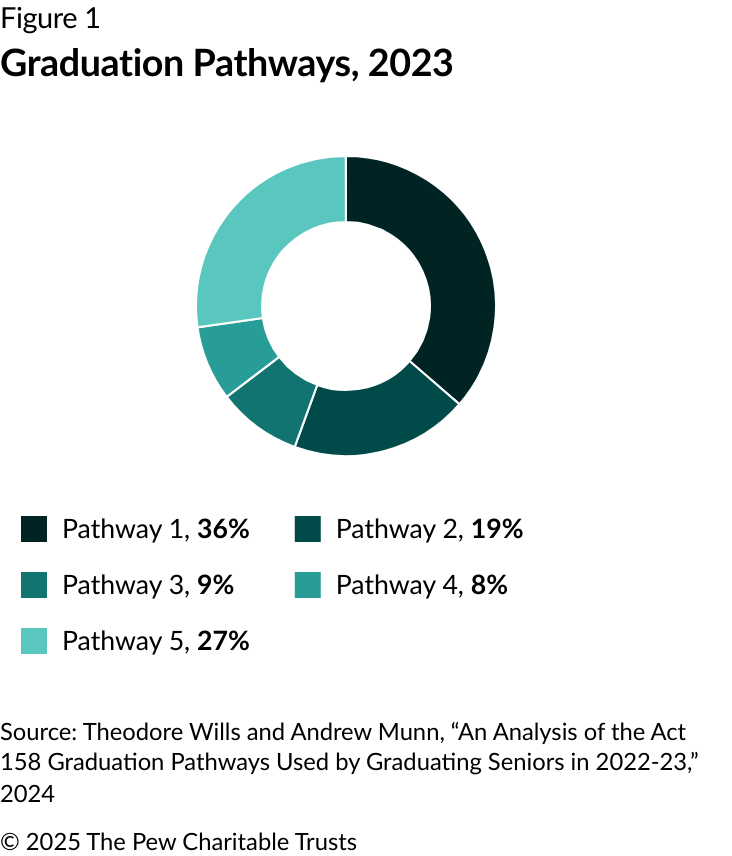
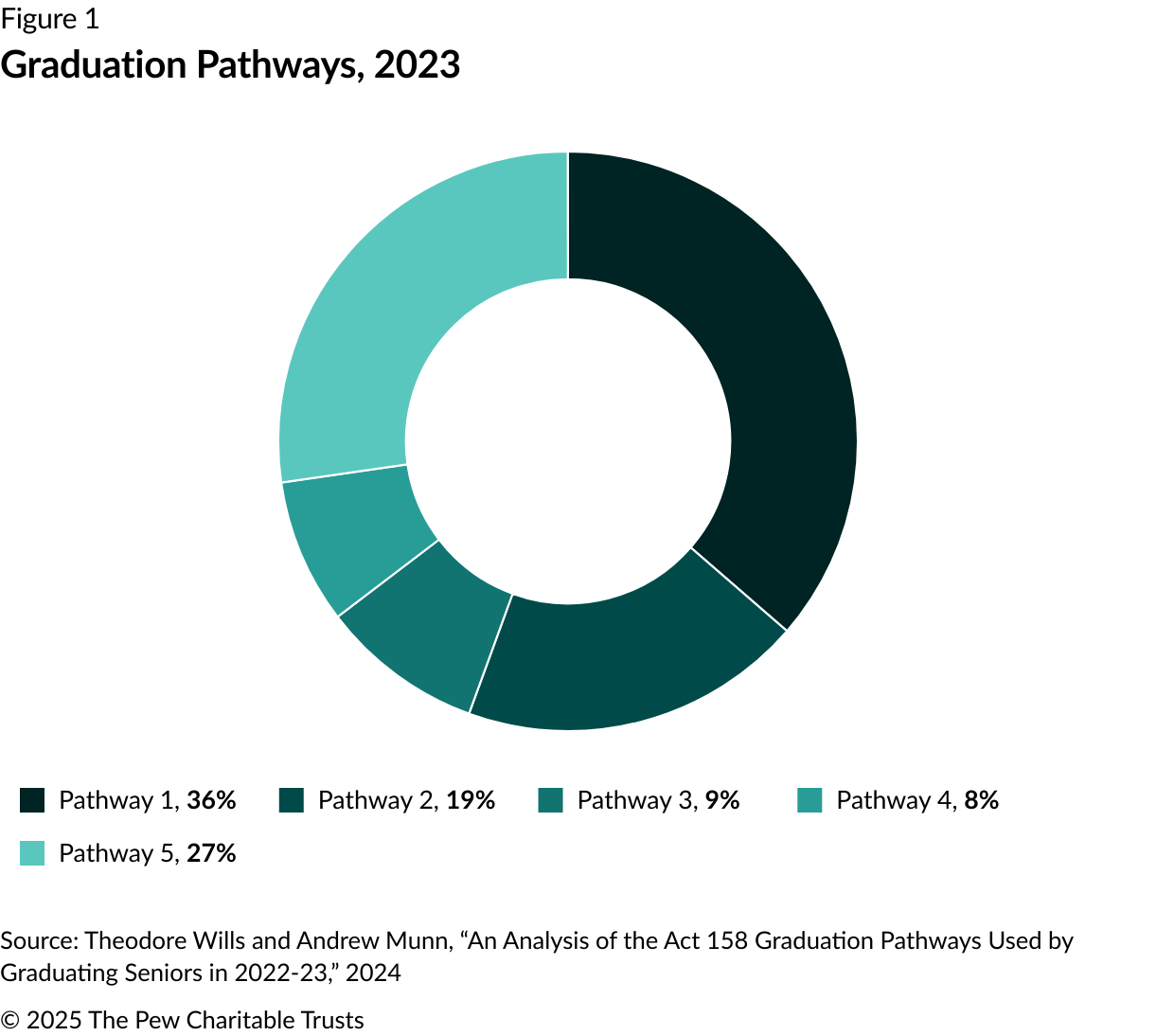
More than a third of students from the class of 2023 (36%) completed Pathway 1, which required students to achieve a
score of proficient or better on Keystone Exams, standardized, state-mandated tests designed to assess students’
proficiency in algebra, biology, and literature. Another 19% of students completed Pathway 2, which requires a
combined score of 4,452 or higher out of 5,400 on all three Keystone Exams. Nine percent completed Pathway 3, which
focuses on career and technical education; 8% completed Pathway 4, which offers college-level coursework and
pre-apprenticeship training. And the remaining 27% opted for Pathway 5, which requires acceptance to a four-year
institution, guaranteed full-time employment, or military enlistment.3
During the 2019-23 period, West Kensington had more than twice the share of residents with less than a high school
education and a greater share of residents living below the poverty level than the city at large. East Oak Lane had
levels of educational attainment and labor participation similar to those of Philadelphia overall but reported a
smaller share of residents living below the poverty level and a declining number of college-educated residents.
Philadelphians with college degrees generally have higher earnings than those without degrees; they are also more
likely to be in the labor force and less likely to live in poverty. Residents with a disability and those with
limited English proficiency often face additional barriers to employment. About 70% of Philadelphians over age 16
who reported having a disability said they were not in the labor force; for limited English speakers, the figure was
48%.
Table 1
Philadelphia, West Kensington, and East Oak Lane Demographics
Educational attainment, labor force participation, and population below the poverty line
| Philadelphia | 13% | 46% | 35% | 65% | 7% | 22% |
|---|---|---|---|---|---|---|
| West Kensington | 28% | 38% | 30% | 63% | 9% | 31% |
| East Oak Lane | 10% | 50% | 30% | 59% | 7% | 16% |
Notes: The labor force participation rate includes residents who are either employed or unemployed and
actively looking for work. All columns except the one representing the share of the population living below
the poverty level include only those ages 25 and older.
Sources: U.S. Census Bureau, American Community Survey, “Educational Attainment”; U.S. Census Bureau,
American Community Survey, “Educational Attainment and Employment Status,” 2019-23 five-year estimates
Northwest Philadelphia and Center City have the highest proportion of college graduates—more than 75% of residents in
these neighborhoods have college degrees. There are other neighborhoods, predominantly in North and Northeast
Philadelphia, where most residents have less than a high school education. These areas present opportunities for
targeted interventions to support educational attainment, which could increase labor force participation.

West Kensington
The West Kensington neighborhood, in North Philadelphia, has its northern border at Lehigh Avenue. About 67% of its
roughly 13,200 residents are over age 25, and 37% are not in the labor force, meaning they are neither working nor
looking for work. It is home to Fairhill Park, which was once a lively commercial and industrial hub along American
Street. After nearby workplaces such as factories closed, the adjacent neighborhood of Kensington became the subject
of troubling national headlines associating the area with blight and an open-air drug market.
In 2023, most residents in West Kensington (72%) had at least a high school education. Twenty-eight percent did not
complete high school—the citywide figure is 13%. (See Figure 2.)
In recent years, the neighborhood has seen a marked increase in educational attainment. The share of residents
without a high school diploma fell by an estimated 66% over the past decade, compared with a 27% decrease citywide
during the same period.


Demographic data on educational attainment reveals that most West Kensington residents with a high school diploma or
some college education are younger than 35. By contrast, 50% of residents with less than a high school diploma are
65 or older, which aligns with citywide levels. Even so, about a quarter (24%) of the working-age population (ages
25-64) has less than a high school diploma, more than double the city’s share for the same age cohort.
Historical workforce patterns can help explain why some residents didn’t pursue a high school education or more
schooling.
“In Philadelphia, people always ask, ‘What high school did you go to?’” said Ade Lawal, president and founder of
Express Employment Professionals of Philadelphia, a placement firm. “Many of the city’s earlier generations worked
in factories, so changing the view on education and operationalizing a new job market takes time.”
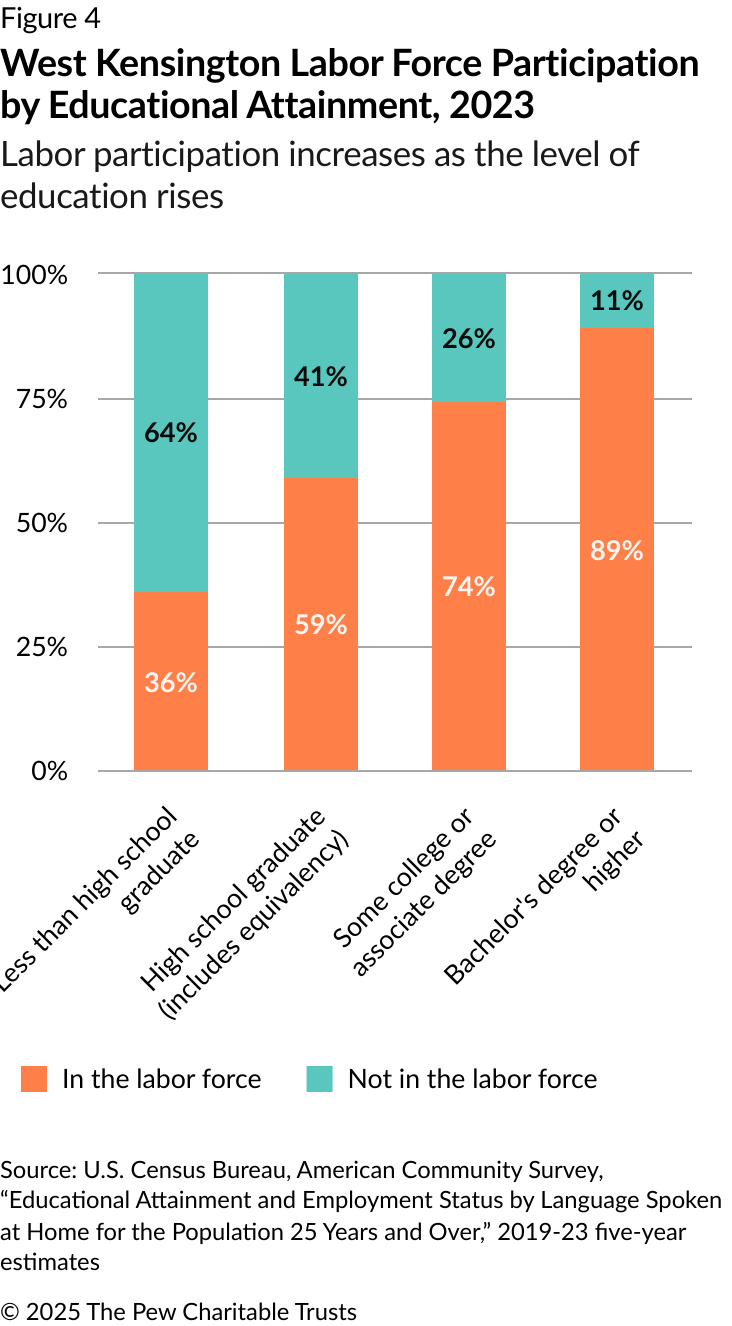
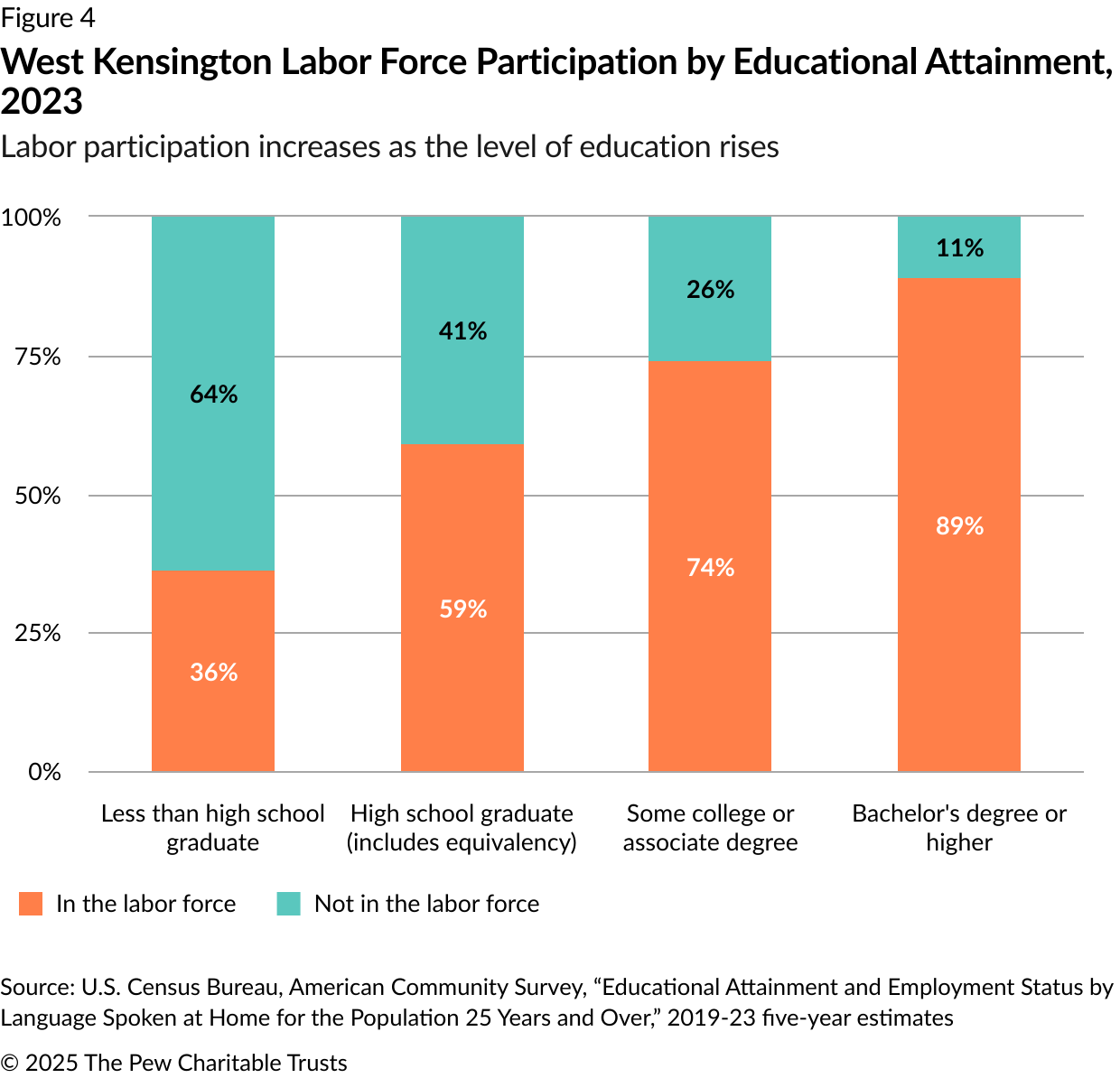
In West Kensington, 59% of residents with a high school diploma or equivalent reported being in the labor force,
compared with 36% of those without a diploma. People without a diploma are less likely to be in the labor force, and
heads of household without a diploma make up 43% of households living below the poverty level. (See Figure 4.)
Although 11.3% of residents citywide said they have limited proficiency in English, in West Kensington, the share is
about 24%. And while about 17% of the population in Philadelphia reports having a disability, in West Kensington,
the figure is 23%.
East Oak Lane
East Oak Lane, in Northwest Philadelphia, is situated along the boundary with Montgomery County and borders Melrose
Park and Cheltenham Township. The community has roughly 12,100 residents, about 75% of whom are over the age of 25
and 41% of whom are not in the labor force. The community is one of the city’s oldest, with some homes dating back
to the 1600s. The neighborhood is mainly residential, consisting primarily of row houses and semi-detached homes.
In 2023, 30% of residents in East Oak Lane had at least a bachelor’s degree, a share similar to the citywide
percentage. The level of educational attainment in East Oak Lane is higher than that of the surrounding
neighborhoods. According to Opportunity Atlas—a web tool created by Opportunity Insights, a collaboration between
the U.S. Census Bureau and Harvard University researchers—children in East Oak Lane have greater economic
opportunities as adults, potentially earning over $10,000 more in median household income than their counterparts in
nearby communities. They also have greater employment opportunities and lower projected incarceration
rates.4
To emphasize career-driven services along with educational attainment—and to help areas attain outcomes similar to
those that this analysis observed in East Oak Lane—Philadelphia launched a “community schools” program in 2016,
establishing 20 specialized public schools in various neighborhoods throughout the city.
“Community schools initially began as a means to address gun violence and meet community-specific needs; today, they
spark knowledge and curiosity for students in sectors like real estate, aviation, farming, and the arts,” said Eli
Prosper, a community schools coordinator in the Mayor’s Office of Education. “It takes a village, and community
schools aim to be that village.”
Ariel Lajara, an assistant superintendent at the School District of Philadelphia, added that schools—community
schools and otherwise—are as crucial for families and neighborhoods overall as they are for students.
“To create critical thinkers, we must educate the whole child—mentally and socially—and schools must be welcoming
environments for the whole family and the connecting community,” Lajara said.
Despite the higher levels of educational attainment and greater economic opportunities for East Oak Lane residents,
the latest data showed a small dip at the college level among neighborhood residents: The estimated number of people
in the community with at least a bachelor’s degree decreased slightly from 2022 to 2023.

Residents ages 35-44 (42%) are more likely to have a bachelor’s degree or more education than are people 65 or older
(30%). This aligns with the citywide trend of younger people having higher levels of educational attainment.
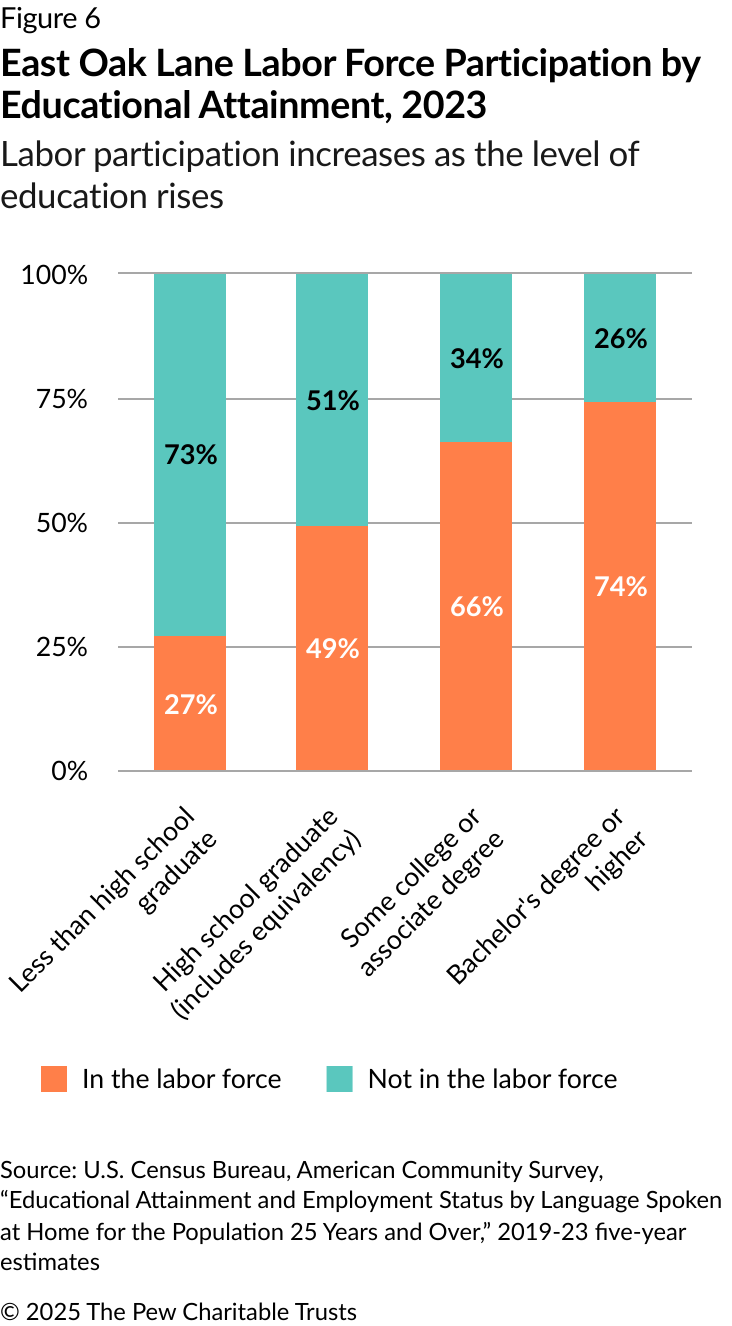
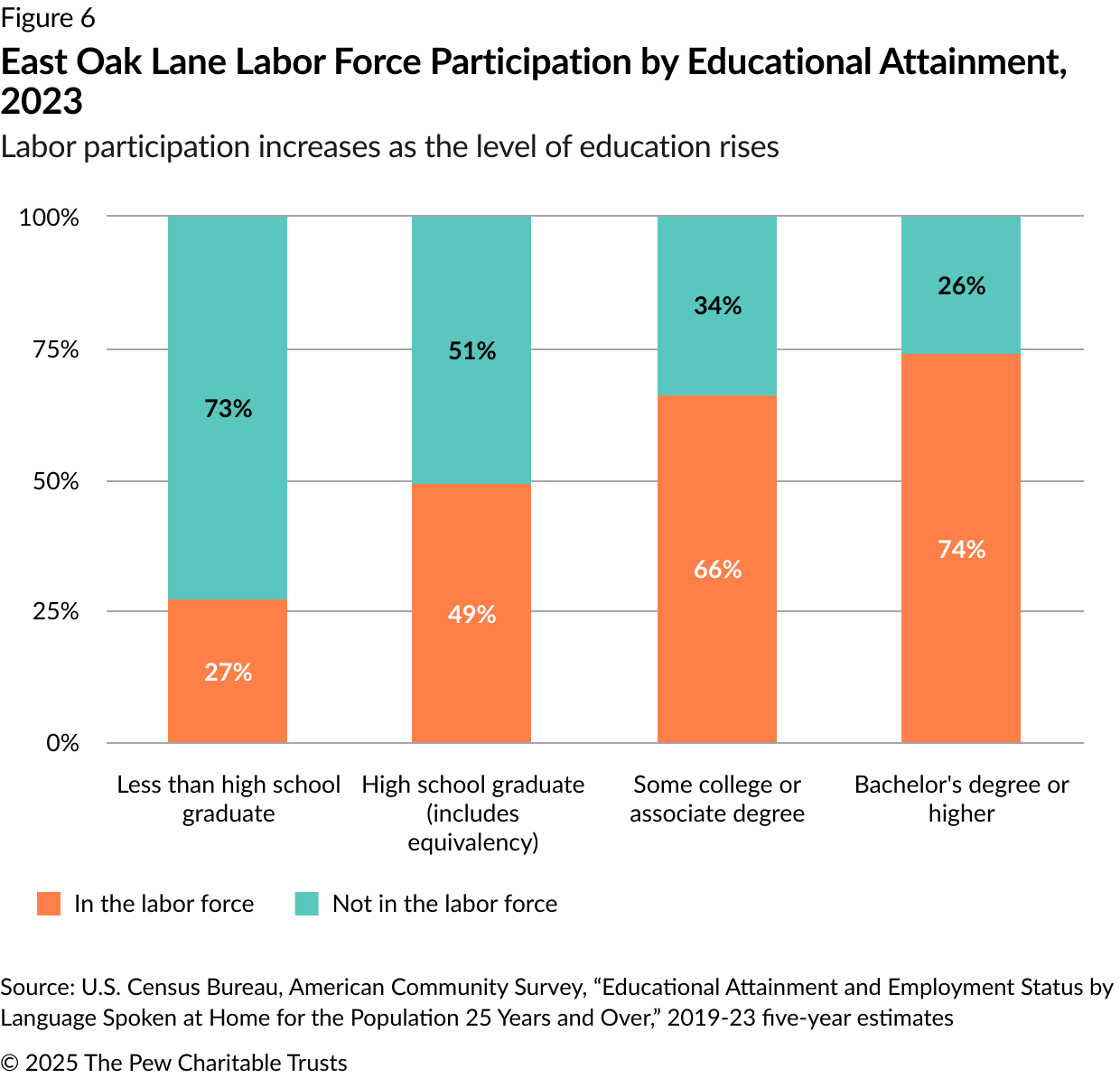
Only 27% of East Oak Lane residents without a high school diploma are in the workforce. Those with at least a
bachelor’s degree make up the greatest share of workers, at 74%. And notably, only about 7% of families in this
neighborhood reported living below the poverty level, compared with 17.5% citywide.
The share of residents with limited English proficiency in East Oak Lane (6%) is significantly lower than the
citywide share (11.3%). Additionally, only a slightly higher share of the neighborhood’s residents (19%) report
having a disability, compared with 17% of residents citywide.
Conclusion
Neighborhood-level differences in the percentage of residents obtaining a high school diploma or college degree can
forecast whether communities are likely to prosper or face growing challenges, irrespective of economic changes.
Although educational attainment is increasing throughout Philadelphia, the rate of growth varies among neighborhoods
and, notably, among age groups. Nevertheless, in what was once an industrial city, Philadelphia’s youth are becoming
increasingly educated, which is expanding their employment opportunities.
The stakes for improving educational outcomes are significant: Education can affect residents’ earnings and
employability, as well as their ability to retain their jobs. Therefore, the dollars invested and the strategies
devised to bolster education today will play a large role in shaping the workforce—and the neighborhoods—of
tomorrow.
Endnotes
- Stephanie R. Miller, “College Preparation, Aspirations, and Enrollment Among Students in Philadelphia
Neighborhoods: An Investigation Using GIS Analysis and Logistic Regression” (dissertation, Temple University,
2009), - Raj Chetty et al., “Changing Opportunity: Sociological Mechanisms Underlying Growing Class Gaps and Shrinking
Race Gaps in Economic Mobility,” Opportunity Insights, 2024, - Andrew Munn and Theodore Wills, “An Analysis of the Act 158 Graduation Pathways Used by Graduating Seniors in
2022-23,” The School District of Philadelphia, 2024, - Raj Chetty et al., “Changing Opportunity.”
link

![Student Loan Debt Statistics [2026]: Average + Total Debt](https://educationdata.org/wp-content/uploads/2025/03/page-1-3.png "Student Loan Debt Statistics [2026]: Average + Total Debt")