Innovative learning approach
October 14, 2024
Written by Amy Cherry
| Photos by Amy Cherry and Ashley Barnas Larrimore
Martens’ Physiology of Aging class brings world-renowned experts into classroom
A year ago, Erica Johnson’s father was diagnosed with stage four non-clear cell renal cell carcinoma. The rare, aggressive form of cancer can be difficult to diagnose.
“The kidneys were hard for me to understand, so I studied them extensively before my comprehensive exam,” said Johnson, a third-year doctoral student in the University of Delaware College of Health Sciences’ Applied Physiology PhD Program.
Her studying and advanced knowledge paid off. Johnson’s father might never have received his diagnosis had she not shown up to his appointments, asked specific questions, and advocated on his behalf.
Her doctoral studies remain relevant to her father’s treatment and her research interests. Johnson, who also got her undergraduate degree in health behavior science from UD, is currently enrolled in Associate Professor of Kinesiology and Applied Physiology Christopher Martens’ Physiology of Aging (KAAP 640) class.
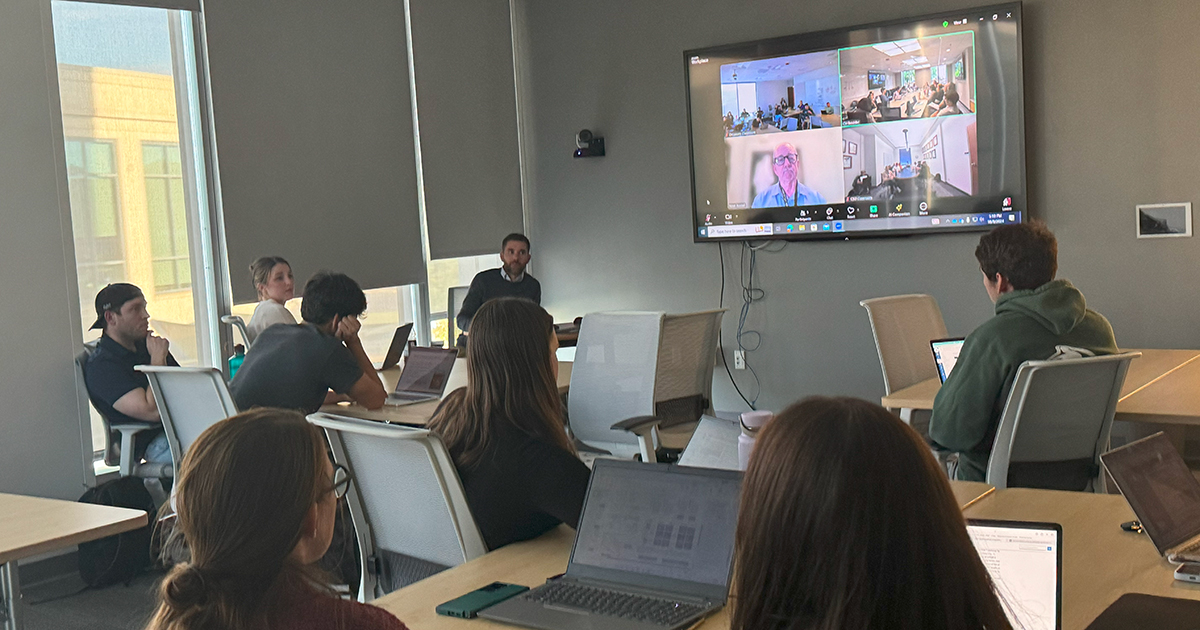
The innovative class is taught in collaboration with Associate Professor Tom LaRocca at Colorado State University (CSU) and Professor Douglas Seals at the University of Colorado Boulder (CU Boulder), where Martens and LaRocca were postdoctoral fellows between 2014 and 2017. While at CU Boulder, Martens and LaRocca co-led the class with Professor Seals. At the time, they leveraged Skype to connect the classroom to world-renowned speakers at a single site.
Years later, Martens wanted to start a similar class at UD, and instead of reinventing the wheel, he joined forces. Now, students from UD learn virtually alongside their peers from CSU and CU Boulder as they meet in their respective classrooms on Tuesdays at 4 p.m. (EST). Each week, they hear from a different expert in aging over Zoom and ask questions.
“Students hear from experts at conferences but rarely get the opportunity to engage with them and ask questions,” said Martens. “These lectures are also tailored for our class, adding value each week.”
Getting older is the number one risk factor for nearly all of today’s leading causes of disease and disability. The course exposes students to the challenges of an aging society, including its impact on the healthcare system and potential strategies for increasing “healthspan” – the period of life in which we remain healthy and free of chronic disease. Speakers range from medical doctors, such as geriatricians, to researchers across various disciplines, from molecular biology to population health.
link