When more means less: the declining happiness premium of higher education in wealthier countries
Data and sample
The present study adopts a cross-country approach, using data from the European Social Survey (ESS). This dataset includes information on the European population aged 15 or above in 36 countries. After 2010, the European Social Survey (ESS) conducted seven rounds of data collection, from Wave 5 to Wave 11. The most recent wave, Wave 11, took place in 2023. In the present analysis, data from Waves 5 to 11 were pooled together. Although this is not a panel survey, several previous studies have confirmed that combining multiple waves can produce more generalizable and robust results (Felaco and Parola, 2022; Hoogerbrugge et al., 2022). For the present analysis, only 172,228 observations were used. Observations with missing values for the variables under consideration were removed from the pooled dataset. The sample included individuals aged 21 to 65. Details of all variables and demographic characteristics are provided in the supplementary materials (S-Table 1). All individual-level variables are included at level one, and countries are considered at level two. Country-level variables are taken from the Legatum Prosperity Index and World Bank data on GDP per capita.
Variables
Subjective well-being is commonly measured in the form of life satisfaction, which in this survey is assessed using the Cantrill ladder. On this scale, 0 indicates extreme unhappiness and 10 indicates extreme happiness. Life satisfaction, as measured by this question, was used as the dependent variable in this analysis due to the well-established reliability of the measure (Diener, 2009).
The main predictor variable used was the level of education. The level of education was measured by the highest qualification obtained, classified initially into seven categories: 1. Less than lower secondary, 2. lower secondary, 3. lower-tier upper secondary, 4. upper-tier upper secondary, 5. advanced vocational/sub-degree, 6. undergraduate, and 7. postgraduate. For the present analysis, these categories were reclassified into four: Secondary or less than secondary education (1 and 2), upper secondary education/High school (3 and 4), advanced vocational qualification (5), and Tertiary level qualification (6 and 7). For further analysis, this was categorized into a dummy variable indicating Highly Educated (HE) and Less Educated (LE). “Highly educated” refers to individuals with a tertiary degree or higher (6 and 7).
Subjective well-being is often defined as the result of observable life circumstances (including both economic and non-economic benefits) relative to life expectations, where these expectations influence the reported level of life satisfaction (Frey and Stutzer, 2010). When life circumstances exceed or meet expectations, individuals are more likely to report higher life satisfaction. Therefore, life circumstances are considered significant determinants of happiness, and are considered vital outcomes of higher education (Clark et al., 2015; McBride, 2010). Education plays a crucial role in shaping life expectations, and pursuing higher education may lead to higher expectations. To meet these expectations, individuals often require resources such as satisfactory income, strengthened social networks, and better health. However, well-being research indicates that the positive effects of education on well-being may diminish as aspirations or expectations increase (Clark et al., 2015). Therefore, key life circumstances, as suggested by Frey and Stutzer (2010), are considered when analyzing the data.
Various life circumstances can influence subjective well-being and may moderate the effect of education. Therefore, income was included as a life circumstance variable, as having income can increase happiness, even when controlling for education and other factors (Clark and Oswald, 1994; Kristoffersen, 2018). Subjective health is also a well-established predictor of happiness, as numerous studies have consistently shown. Labor market integration is captured in the employment status variable, which includes the categories of employed, unemployed, and not in the labor force.
Social capital, or strong social networks, can significantly impact happiness by helping individuals cope with challenges and building resilience. Research suggests that having someone to rely on is crucial for maintaining well-being (Chen, 2012; Puntscher et al., 2015). Although social capital is a complex construct to measure, studies often use the question, “Most people can be trusted, or you can’t be too careful,” to assess the level of trust, which serves as an indicator of social capital (Puntscher et al., 2015). Despite the existence of other measures, this question is frequently used to gauge social capital in terms of trust. Therefore, in the present analysis, this question was included as an indicator of social capital. Since marital status is also considered a key social benefit of education, it is included in the regression stepwise. Marital status in the ESS is measured as a categorical variable with several categories; however, for this study, a new variable was created with five categories (Married, Divorced, Separated, Widowed, Single or Other).
Several control variables were also included, such as gender (represented by a female dummy), age, age squared, the number of members in the household, religiousness, and place of residence. Inclusion of these variables is informed by previous studies (Batuwanthudawa and Udayanga, 2025; Dolan et al., 2008; McCrae and John, 1992).
Legatum Prosperity Index and GDP per capita (log) were used as country-level variables (Card, 1999; Michalos, 2008). The Legatum Prosperity Index is a global ranking developed by the Legatum Institute that measures prosperity across countries, extending beyond merely economic well-being. It considers twelve dimensions of a country’s social, economic, and political conditions, including safety, personal freedom, governance, social capital, and economic quality, among others (for more details, please visit its website). Thus, this indicator provides a broader perspective than the Human Development Index, which primarily focuses on human development. Nevertheless, the two indices are highly correlated. The mean Legatum Prosperity Index score across selected years (2010, 2012, 2014, 2016, 2018, 2020, and 2023) was used for the present analysis. In addition, GDP per capita (log-transformed) was employed as a measure of a country’s economic prosperity (Stevenson and Wolfers, 2008). Similar to the Legatum Prosperity Index, the mean GDP per capita (in log form) across the respective years was used. In the robustness analysis, IHDI (inequality-adjusted human development index) and Governance effectiveness indexes were used.
In each analysis model, year dummies were included to account for variations observed across the years.
Methods
A multilevel linear regression model (MLM) was adopted to account for individual and country-level factors. While multilevel ordinal logistic regression could also be used, previous studies suggest that the results from multilevel ordinal logistic regression are quite similar, with minimal differences (Araki, 2022; Ferrer-i-Carbonell, 2005; van Praag et al., 2003). Therefore, multilevel linear regression was selected for this analysis. With an intra-class correlation of 0.13 for the life satisfaction (LS) variable, the use of MLM was justified. Firstly, to explore the association between level of education and life satisfaction (or subjective well-being), only individual-level variables were considered and analyzed in a stepwise manner (Bartram, 2021). Although no country-level predictors were included, this model specified a random intercept for each country. This allows the model to account for differences in the baseline level of the LS across countries (Peugh, 2010; Snijders and Bosker, 2012). This strategy was used to analyze individual-level predictors while accounting for random intercepts at the country level. Random intercept models allow for the variation of intercepts across countries. (MLMs were implemented using Stata 19.5)
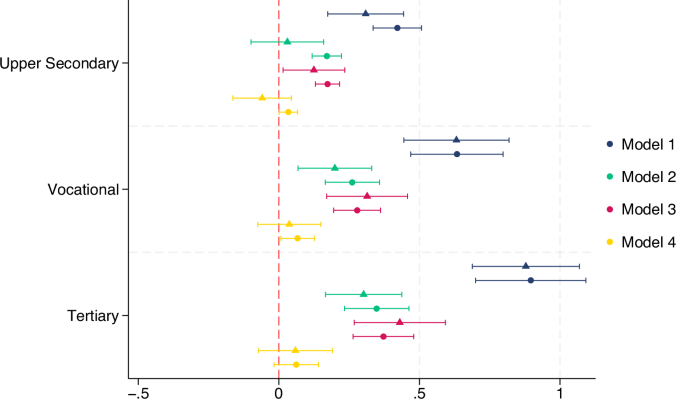
To examine the association between education and life satisfaction, and the potential mediation by economic and social benefits (life circumstances), a random intercept model was first specified, as shown in Equation 1. This equation represents the full model applied to the combined sample of men and women, including all life circumstance variables (see Table 1). In each model presented in Table 1, certain adjustments were made to the equation specification, as detailed in the supplementary materials (Section 4). Model 1 excludes all life circumstance variables. Model 2 includes financial benefits, while Model 3 incorporates social benefits. Model 4 includes all life circumstance variables (both financial and social benefits). Each model was estimated separately for male and female subsamples. All models include the main predictor variable and other controls.
Random intercept model:
$$\begin{array}{c}{Y}_{{ij}}={\beta }_{0j}+\,{\beta }_{1}{X}_{{ij}}+\,{\varepsilon }_{{ij}}\\ {\beta }_{0j}={\gamma }_{00}+\,{\mu }_{0j}\end{array}$$
$${Y}_{{ij}}={\gamma }_{00}+\,{\gamma }_{10}{X}_{{ij}}+{\mu }_{0j}\,+\,{\varepsilon }_{{ij}}$$
Please refer: (Snijders and Bosker, 2012)
and hence Equation 1,
$$\begin{array}{l}{Y}_{{ij}}={\gamma }_{00}+\,{\gamma }_{10}{{Eb}}_{{ij}}+{\gamma }_{20}{{Ec}}_{{ij}}+\,{\gamma }_{30}{{Ed}}_{{ij}}+\,{\gamma }_{40}{A}_{{ij}}\,+\,{\gamma }_{50}{{A}^{2}}_{{ij}}+\,{\gamma }_{60}{R}_{{ij}}+\,{\gamma }_{70}{G}_{{ij}}+\\\,{\gamma }_{80}{{HM}}_{{ij}}+\,{\gamma }_{90}{{PLb}}_{{ij}}+\,{\gamma }_{100}{{PLc}}_{{ij}}+\,{\gamma }_{110}{{PLd}}_{{ij}}+\,{\gamma }_{120}{{PLe}}_{{ij}}+\,{\gamma }_{130}{{HIb}}_{{ij}}+\,{\gamma }_{140}{{HIc}}_{{ij}}+\\\,{\gamma }_{150}{{HId}}_{{ij}}+\,{\gamma }_{160}{{HIe}}_{{ij}}+{\gamma }_{170}{{UN}}_{{ij}}+{\gamma }_{180}{{NL}}_{{ij}}+{\gamma }_{190}{{MSS}}_{{ij}}+{\gamma }_{200}{{MSb}}_{{ij}}+{\gamma }_{210}{{MSc}}_{{ij}}+\\\,{\gamma }_{220}{{MSd}}_{{ij}}+\,{\gamma }_{230}{{MSe}}_{{ij}}\,+\,{\gamma }_{240}{{SHb}}_{{ij}}+\,{\gamma }_{250}{{SHc}}_{{ij}}+{\gamma }_{260}{{SHd}}_{{ij}}+{\gamma }_{270}{{SHe}}_{{ij}}+\\{\gamma }_{280}{{TR}}_{{ij}}+\,{\gamma }_{290}{{SYb}}_{{ij}}+\,{\gamma }_{300}{{SYc}}_{{ij}}+{\gamma }_{310}{{SYd}}_{{ij}}+{\gamma }_{320}{{SYe}}_{{ij}}+{\gamma }_{330}{{SYf}}_{{ij}}+{\gamma }_{340}{{SYg}}_{{ij}}+\\\,{\mu }_{0j}\,+\,{\varepsilon }_{{ij}}\end{array}$$
Where i = level one (individual), j = level two (country), Yij = level of life satisfaction for individual i in country j, γ00 = average intercept, γn = coefficient of individual level predictor variables, Ebij = level of education achieved: upper secondary dummy, Ecij = level of education achieved: Vocational dummy, Edij = level of education achieved : Tertiary degree or above dummy, Aij = Age, A2ij = age squared, Gij = gender (female dummy), Rij = religiousness, HMij = number of members in the household, PLbij = the place of living: Suburb dummy, PLcij = the place of living: Small City dummy, PLdij = the place of living: Country village dummy, PLeij = the place of living: Farm or countryside dummy, HIbij = household income: category 2 dummy, HIcij = household income: category 3 dummy, HIdij = household income: category 4 dummy, HIeij = household income: category 5 dummy, UNij = unemployed dummy, NLij = not in the labor force dummy, MSbij = marital status: separated dummy, MScij = marital status: divorced dummy, MSdij = marital status: widowed dummy, MSeij = marital status: single dummy, SHbij = subjective health: good dummy, SHcij = subjective health: fare dummy, SHdij = subjective health: bad dummy, SHeij = subjective health: very bad dummy, TRij = trust, SYbij = survey year: wave 6 dummy, SYcij = survey year: wave 7 dummy, SYdij = survey year: wave 8 dummy, SYeij = survey year: wave 9 dummy, SYfij = survey year: wave 10 dummy, SYgij = survey year : wave 11 dummy, ɛij = residual for individual i in the country j. µ0j = country dependent deviation of the intercept. (reference categories are not included:- level of education: secondary or less, household income: category 1, marital status: Married, place of living: A big city, subjective health: Very Good, survey year: Wave 5, employment status: employed)
Secondly, along with Hypotheses 1, 2, and 3, multilevel mediation analysis (MMA) was employed to identify the total and indirect effects of higher education on subjective well-being. MMA allows for modeling complex relationships mediated through intermediary variables, determining the extent to which effects are channeled through moderators to the outcome variable. A 1-1-1 MMA model was applied in the present analysis. By allowing for a subject variation, the individual-level associations between education and life satisfaction, mediated by the benefits of higher education, were estimated separately for men and women. Higher education was specified to covary with subjective well-being at the country level (subject variation) (Pan et al., 2018). This specification has been previously tested by several studies (Tofighi and Thoemmes, 2014; Xie et al., 2015). Household income, Employment status (Employed dummy), subjective health, marital status (Married dummy), and social trust are considered mediators between education (having a tertiary level or above qualification) and subjective well-being. All other control variables are also considered in the model.
Using R lavaan, a multilevel mediation analysis was conducted, and both direct and indirect effects of education on subjective well-being were obtained. Then, to identify the significance of total and indirect effects between men and women, a multivariate Wald test was conducted. In multilevel mediation analysis, the multivariate Wald test can be used to assess the significance of mediation effects at different levels of the data (Preacher et al., 2011). Therefore, the Wald test was used to assess the significance of gender differences in the total indirect economic effects of education, the total indirect effects via social benefits, and the overall total indirect effects. Maximum likelihood estimation with robust standard errors was used for all models, with analytical weights applied as recommended by ESS. (Full analytical model for MMA is in the supplementary materials- Section 4).
To test Hypothesis 4, MLM was employed (Tables 3 and 4), including country-level variables and their interactions with education. Given the importance of incorporating random slopes for country-level variables involved in cross-level interactions (Equation 2), Tables 3 and 4 include random slopes. (Refer to supplementary materials for full analytical details: Section 4).
Random Slope model:
$${Y}_{{ij}}={\beta }_{0j}+\,{\beta }_{1}{X}_{{ij}}+\,{\varepsilon }_{{ij}}$$
$$\begin{array}{c}{\beta }_{0j}={\gamma }_{00}+\,{\mu }_{0j}\\ {\beta }_{1j}={\gamma }_{10}+\,{\mu }_{1j}\end{array}$$
$${Y}_{{ij}}={\gamma }_{00}+\,{\gamma }_{10}{X}_{{ij}}+{\mu }_{0j}\,+\,{\mu }_{1j}{X}_{{ij}}+{\varepsilon }_{{ij}}$$
With cross-level interaction:
$$\begin{array}{c}{\beta }_{0j}={\gamma }_{00}+\,{\gamma }_{01}{z}_{j}+\,{\mu }_{0j}\\ {\beta }_{1j}={\gamma }_{10}+\,{\gamma }_{11}{z}_{j}+\,{\mu }_{1j}\end{array}$$
$${Y}_{{ij}}={\gamma }_{00}+{\gamma }_{01}{z}_{j}\,+\,{\gamma }_{10}{X}_{{ij}}+\,{\gamma }_{11}{z}_{j}{X}_{{ij}}\,{+\mu }_{0j}\,+\,{\mu }_{1j}{X}_{{ij}}+{\varepsilon }_{{ij}}$$
Refer to: (Snijders and Bosker, 2012)
and hence Equation 2,
$$\begin{array}{l}{Y}_{{ij}}={\gamma }_{00}+\,{\gamma }_{10}{E}_{{ij}}+{\gamma }_{20}{A}_{{ij}}\,+\,{\gamma }_{30}{{A}^{2}}_{{ij}}+\,{\gamma }_{40}{R}_{{ij}}+\,{\gamma }_{50}{G}_{{ij}}+\,{\gamma }_{60}{{HM}}_{{ij}}+\,{\gamma }_{70}{{PLb}}_{{ij}}\\\qquad+\,{\gamma }_{80}{{PLc}}_{{ij}}+\,{\gamma }_{90}{{PLd}}_{{ij}}+\,{\gamma }_{100}{{PLe}}_{{ij}}+\,{\gamma }_{110}{{HIb}}_{{ij}}+\,{\gamma }_{120}{{HIc}}_{{ij}}+\,{\gamma }_{130}{{HId}}_{{ij}}+\,{\gamma }_{140}{{HIe}}_{{ij}}\\\qquad+{\gamma }_{150}{{UN}}_{{ij}}+{\gamma }_{160}{{NL}}_{{ij}}+{\gamma }_{170}{{MSS}}_{{ij}}+{\gamma }_{180}{{MSb}}_{{ij}}+{\gamma }_{190}{{MSc}}_{{ij}}+\,{\gamma }_{200}{{MSd}}_{{ij}}\\\qquad+\,{\gamma }_{210}{{MSe}}_{{ij}}\,+\,{\gamma }_{220}{{SHb}}_{{ij}}+\,{\gamma }_{230}{{SHc}}_{{ij}}+{\gamma }_{240}{{SHd}}_{{ij}}+{\gamma }_{250}{{SHe}}_{{ij}}+{\gamma }_{260}{{TR}}_{{ij}}\\\qquad+\,{\gamma }_{270}{{SYb}}_{{ij}}+\,{\gamma }_{280}{{SYc}}_{{ij}}+{\gamma }_{290}{{SYd}}_{{ij}}+{\gamma }_{300}{{SYe}}_{{ij}}+{\gamma }_{310}{{SYf}}_{{ij}}+{\gamma }_{320}{{SYg}}_{{ij}}+\,{\gamma }_{01}{{CP}}_{j}\,\\\qquad+{\gamma }_{11}{E}_{{ij}}{{CP}}_{j}\,+\,{\mu }_{1j}{E}_{{ij}}+\,{\mu }_{0j}\,+\,{\varepsilon }_{{ij}}\end{array}$$
Where, γ10Eij = Highly Educated dummy, µ1j = country dependent deviation of the education slope, γ01CPj = country level predictor (GDP or Legatum prosperity index), γ11EijCPj = interaction between education and the country level predictor. Other individual-level variables are similar to those in Equation 1. Equation 2 was directly applied in Model 1 in Tables 3 and 4. However, certain changes were made in other models (Refer to supplementary materials: Section 4).
Moreover, to ensure that results were not reliant on specific countries (outliers), several countries were excluded in the robustness check. The endogeneity bias is checked using personality characteristics. At the country level, the inequality-adjusted human development index and governance effectiveness were included as additional covariates, in addition to GDP per capita. A full explanation of the robustness check can be found in the supplementary materials.
link

![Student Loan Debt Statistics [2026]: Average + Total Debt](https://educationdata.org/wp-content/uploads/2025/03/page-1-3.png "Student Loan Debt Statistics [2026]: Average + Total Debt")