


Conventional models of intergenerational educational mobility
Previous research on the influence of contextual factors on IEM across regions has developed two main theories: the economic development theory and the social inequality theory.
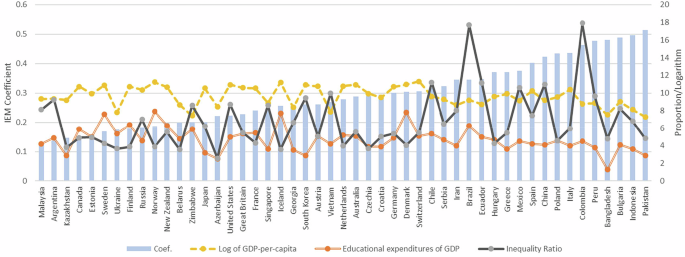
The economic development theory assumes that IEM would decrease when increasing the children’s educational attainment in the general society, especially the lower social classes and it contains two main hypotheses. The industrialization hypothesis holds two mechanisms of structural changes and social choice to lift the IEM (Lipset and Zetterberg, 1959; Erikson and Goldthorpe, 1992). The public support hypothesis is enlightened by the human capital models (Becker and Tomes, 1979) by arguing that the government’s public funding of education can make up for the lack of human capital investment in education by families with lower socioeconomic status (Roy, Basu and Roy, 2022). In empirical studies, economic development is usually measured by per-worker GDP or GDP per capita, and higher GDP per capita is associated with lower IEM (Yaish and Andersen, 2012; Neidhöfer, Serrano and Gasparini, 2018). People have higher educational outcomes in more developed regions with more public support investments (Aydemir and Yazici, 2019), otherwise, in a region with few public education scholarships and poor infrastructure, the educational persistence between generations is strong (Roy, Basu and Roy, 2022).
The social inequality theory assumes that IEM would rise when the polarization of the education level of children’s generation rises. The positive relationship between social inequality and IEM has two explanations: the educational resource inequality hypothesis and the cost-benefit of education hypothesis. The former believes that inequality concentrates wealth and resources in the upper social class and exacerbates stratified social outcomes originating from family traits, allowing social class with competitive privileges to provide resources, structure policies, and shape opportunities to ensure the persistence of education and occupation (Corak, 2013). The lack of adequate resources in the lower social class would result in children’s decreasing upward educational mobility (Wang and Wu, 2023). The sustain, even the expansion, of education inequality would increase IEM. The latter considers that inequality would increase closed social opportunity, making the cost-benefit ratio of educational investment in the lower social class even lower, so that they are more likely to refrain from taking risky chances (Jackson and Schneider, 2022). The level of IEM would be higher if lower-class children’s educational attainment remained constant or even declined, while upper-class children have higher educational attainment. Neidhöfer, Serrano, and Gasparini (2018) compared intergenerational educational persistence in Latin America and showed a significantly positive relationship with inequality, measured by the Gini coefficient of disposable household per capita income.
The industrialization theory, though, contains gaps in its justification that the link between modernization and IEM can only be observed in a nation with high levels of economy (Yaish and Andersen, 2012). This perspective tends to overlook constraints from social structures. The relationship between social inequality and IEM is also debatable. Liberal economists and structural-functional sociologists hold the view that social inequality encourages individuals to pursue higher levels of education and employment depending on skill and necessity through unequal incentives and rewards (Davis and Moore, 1945).
Incorporating the intrinsic connection between contextual factors’ effects on intergenerational educational mobility
Social inequality spans multiple dimensions and levels, such as digital skills gap, inequitable legal protections, wealth accumulation and poverty perpetuation, gender and racial discrimination, etc., encompassing disparities and unfairness arising from the unequal distribution of resources, power, opportunities, or social status (Goldthorpe, 2010; Raudenbush and Eschmann, 2015). The current study focuses on income inequality, which represents a significant aspect of social inequality, and examines how economic contexts influence individual educational opportunities and the disparities therein. The integrative and divisive forces embedded within the economic dimension of different countries shape the opportunities and constraints individuals in attaining education.
We contend that the previous theories show inconsistent or contradictory results for not incorporating the interrelation of the effects on IEM from social factors. The Kuznets hypothesis (Kuznets, 1955) explored the connection between economic growth and inequality, imposed a certain inverted U curve of income inequality over various stages of economic growth, and inspired research on the possible consequences of social structures (Naguib, 2017; Ail et al., 2022). What about the relations of their impacts on IEM?
The mechanism of structural change under the influence of income inequality. Economic growth drives structural transformation toward technocracy in the labor market and a rise in the educational level of society’s members. Those who initially succeed in seizing the opportunity of market-oriented reform and transform into new social elites are typically individuals with a prominent position in the distribution system and stronger cultural capital and social capital, which would increase the returns of family resources in terms of education and employment (Gerber and Hout, 2004; Yaish et al., 2021). And the rising income inequality would make the feature more pronounced. While higher-class children continue to enter highly skilled fields, the flow effect brought on by industrialization will be mitigated. It can be argued that the vertical segmentation of the labor market has concentrated the young generation of the lower class in jobs with less demanding educational attainment, constraining IEM.
The mechanism of social choice under the influence of income inequality. The growing income inequality shapes how opportunities are distributed in schools and labor markets, where social choice mechanisms primarily take place. In schools, teachers, as agents of the elite, evaluate students using the cultural norms established by the upper class. In the labor market, the lower-class young generations have fewer benefits of human capital because screening criteria for employers are equally dependent on educational attainment and abilities. They may only get employment identical to those of their fathers, restricting prospects for mobility. In conclusion, income inequality reinforces and even worsens the distribution of resources based on socioeconomic rank, the social choice process is subordinated to impediments to class mobility, and the bottom class only receives a limited amount of benefit from the development of meritocracy.
The mechanism of public support under the influence of income inequality. Jackson and Schneider (2022) stated that public spending on education, as a more universal investment, has a top-down effect on family education expenditures, i.e., public investment decreases the education expenditures of high-class households but does not change the expenditures of low-middle-class households. Currently, public education spending in most countries concentrates more on elementary and secondary education rather than tertiary education. When society becomes increasingly unequal, children from low families face fewer marginal enrollment opportunities and fewer options for higher education, and the free-up resources of public education expenditures are scarcely beneficial for them. Although progressive public policies anticipate a steady convergence of the education gap, this objective may be challenging to reach in an unequal society.
By distinguishing the level of income inequality, we assume that under the impact of wealth reproduction and class exclusion, the educational opportunity structure exhibits a trend of closure, similar to the conclusion of the Maximumly Maintained Inequality hypothesis (Raftery and Hout, 1993). Since previous studies have shown that the influences are skewed in the opposite direction, we believe that a comparative viewpoint made up of categorized contextual elements at the individual levels is effective in distinguishing the mixed effects. We propose the following hypotheses that with the increase in income inequality, the mobility-promoting effects of economic growth on IEM would be decreased.
Hypothesis 1a: The impact of economic growth on IEM is weaker in higher unequal countries than in lower unequal countries.
Hypothesis 1b: The impact of public support on IEM is weaker in higher unequal countries than in lower unequal countries.
Gender and cohort differences in the impact of contextual factors on intergenerational educational mobility
We find that previous studies only discuss whether IEM is high or low across groups but do not explore the heterogeneity of the degree of IEM influenced by macro factors across groups. Studies have been done on IEM differences related to gender (Huo and Golley, 2022) and age (Bauer and Riphahn, 2009) to explain the relative advantages of IEM in some privileged social groups. We consider IEM as the intergenerational variance in the educational status of social members. The concept offers a distinctive perspective of social incentives and resource distribution by combining family educational strategy and societal educational opportunity.
Regarding gender differences, the theories of rational choice, family resources, and gender roles assume education preference within the family because of the limited resources (Moen et al., 1997; Meemon et al., 2022). Structural change and social choice mechanisms seek efficiency and require a large labor force to create economic value to drive economic development, so more women are getting educated, participating in the labor market, and releasing themselves from the constraints of the family. Public support mechanisms enable government investment to compensate for the insufficiency of families that might only support boys for schools, making the “superfluous” educational opportunities now available to girls. Thus, the mobility-promoting effects facilitated by the economic development of women are more than that of men. Similar to this, households have a larger tendency to select males as the primary and steady beneficiaries of education when income inequality is on the rise, and girls may be less possible to be supported based on the investment risk of returns from higher education and projected future incomes. As a result, women are more susceptible than men to the effects of changes in the macro social environment.
Regarding cohort differences, the dynamics of structural change and social choice serve as important driving forces, which call for a sizable proportion of the young workforce, resulting in a quick rise in educational attainment in the young cohort. Also, a much bigger role of educational subsidies and welfare is observed in assisting the decrease of economic pressure and access to higher education for the young cohort as a result of broad educational expansion policies around the world. So educational mobility is more strongly moderated by economic development in the young cohort than that in the old cohort. As for the mobility-prohibiting effects of income inequality, we contend that for older cohorts, rising income inequality will make offspring more dependent on parental educational attainment, whereas, for younger cohorts, the abundance of educational institutions and educational options may lengthen the offspring’s years of schooling and weaken the relationship between them and their parental educational attainment. We then propose the following hypotheses:
Hypothesis 2: The influences of economic growth, public educational expenditures, and income inequality on IEM are stronger for women than men.
Hypothesis 3: The mobility-promoting effects of economic growth and public educational expenditures on IEM are stronger for the recent cohort, and the mobility-prohibiting effects of inequality on IEM are stronger for the older cohort.
link